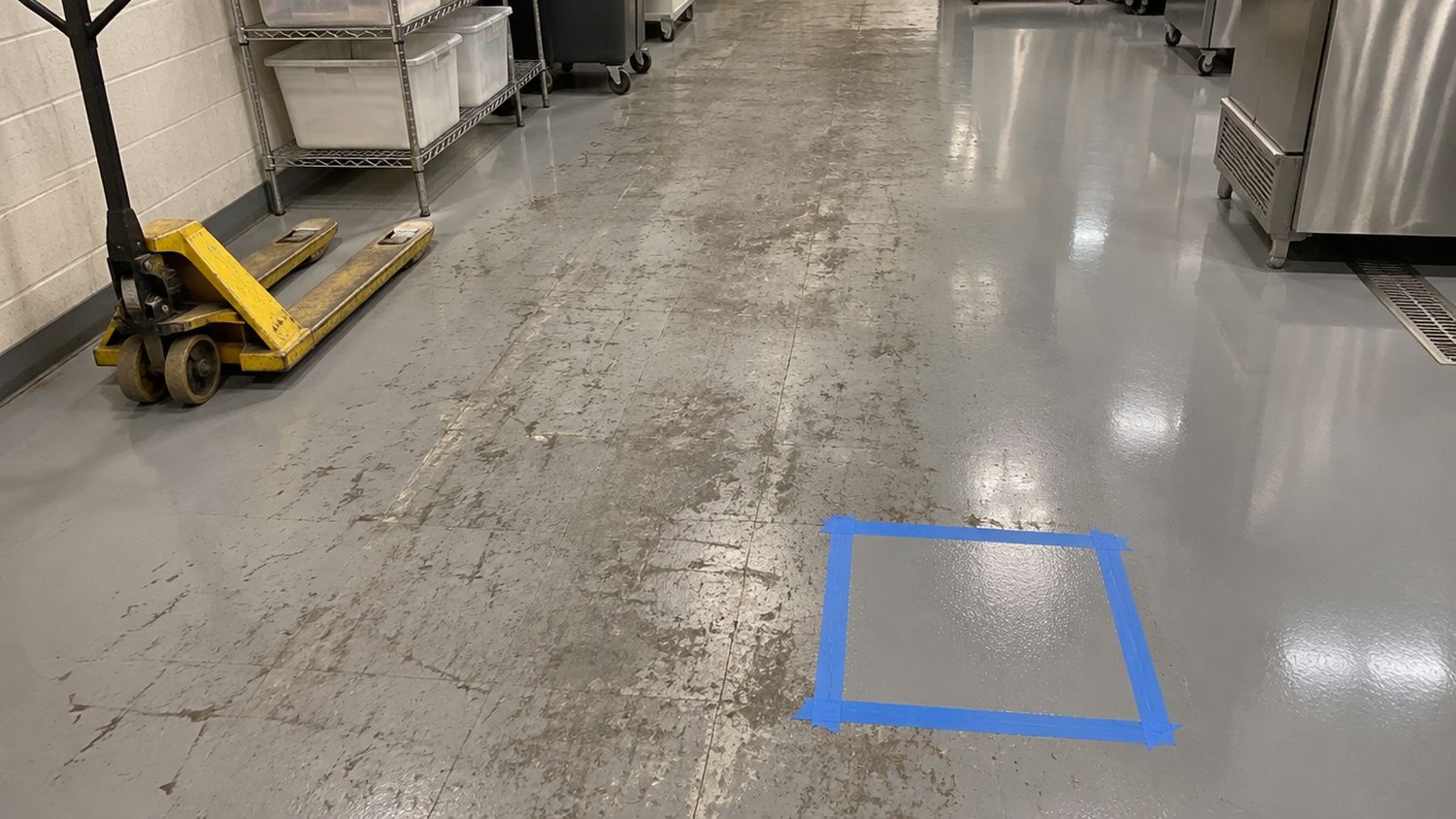
Concrete looks solid, so it is easy to forget that it is full of tiny pores. Water moves through those pores as liquid and as vapour, and it does not stop when you put a coating on top. If moisture vapour is travelling up through the slab, it meets the underside of the floor coating, builds pressure and breaks the bond. The result is blisters, bubbles, soft spots and eventually peeling. This is one of the most common reasons coatings fail, and one of the easiest to prevent. Request a free estimate to discuss your project.
A moisture test before coating tells you whether the slab is ready, whether it needs a moisture-mitigating system, or whether the problem should be fixed at the source first. This article explains the common testing methods, how to read the results and what your options are. If you want a broader picture of failures, see our article on why epoxy floors fail.
Why Moisture and Coatings Do Not Mix
Epoxy and other resin coatings form a dense, low-permeability film. That is a strength when you want to keep spills and chemicals out, but it also traps vapour trying to escape from below. Vapour pressure can build to the point that it lifts the coating from the slab. Even a floor that looks perfect at handover can fail months later when seasonal humidity changes, because moisture levels in a slab are not constant.
The problem is hidden until it is too late. Concrete can feel dry on the surface and still be transmitting vapour. That is why professionals test rather than judge by eye or by touch.
Where Moisture Comes From
- Ground water: slabs on grade and below grade sit against soil that holds water
- No vapour barrier: older slabs were often poured without a barrier underneath, so vapour moves freely upward
- Poor drainage: downspouts, grading or a high water table push water toward the foundation
- New concrete: fresh slabs release water as they cure and need time to dry
- Leaks: plumbing, roof or wall leaks introduce water locally
- Humidity and condensation: warm, humid air meeting a cool slab can leave moisture at the surface
Basements are the most common problem area, which is why we cover moisture in detail on our basement epoxy floor page.
Common Concrete Moisture Tests
There are several test methods in use. They answer slightly different questions, and a good contractor often uses more than one.
Plastic Sheet Test
A square of clear plastic is taped airtight to the slab on all edges and left for a period, commonly 16 to 24 hours or longer. Moisture under the sheet, droplets on its underside or a dark patch on the concrete suggests vapour is moving. This simple test is described in ASTM D4263. It is quick and free of equipment, but it is only a pass or fail indicator and it does not give a number.
Calcium Chloride Test
A dish of calcium chloride is sealed under a dome on the slab for a set time, then weighed to see how much moisture it absorbed. The result is a moisture vapour emission rate. This method is covered by ASTM F1869. It measures what is leaving the surface, not what is deeper in the slab, so readings are affected by the conditions in the room during the test.
In-Situ Relative Humidity Probes
Small probes are placed in holes drilled to a specified depth in the slab and sealed. After the concrete and probe reach equilibrium, the relative humidity inside the slab is read. This method is described in ASTM F2170 and is widely regarded as a reliable way to understand moisture in the body of the concrete, not just at the surface.
Handheld Moisture Meters
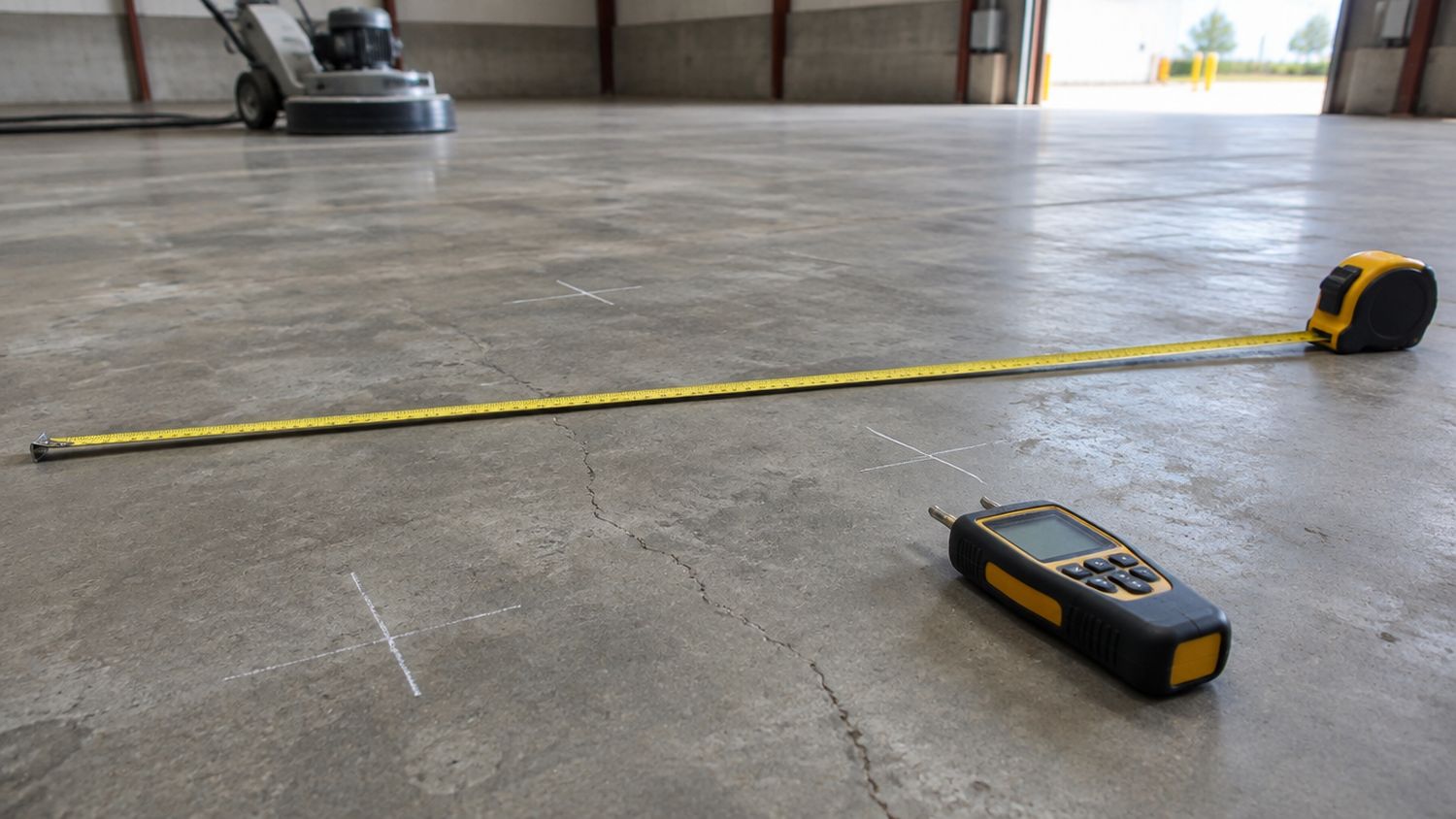
Electronic meters give a quick reading on the surface. They are useful for scanning a large area and finding wet spots to investigate, but they are not a replacement for the standardized tests above. Readings can be affected by the concrete mix and by surface conditions.
Practical approach. Use a meter to scan and find suspect areas, a plastic sheet test as a quick sanity check, and a calcium chloride or in-situ humidity test when the result matters. The more critical the floor and the damper the slab, the more rigorous the testing should be.
How to Read the Results
Every coating manufacturer publishes its own moisture limits for each product, and those limits differ. The reading that is acceptable for one system can be too high for another. Your installer should compare your test result with the limit stated by the manufacturer of the specific system they plan to use, and tell you which side of the line you are on.
- Within limits: the slab is ready for standard preparation and a normal system
- Borderline: a moisture-mitigating primer or membrane may be recommended, or testing repeated after conditions change
- Over limits: the source of moisture needs to be addressed, or a system designed for damp slabs chosen
What to Do When a Slab Is Damp
A high reading is not the end of the project. It simply changes the plan. The options below are commonly used, singly or together, depending on how severe the problem is.
- Fix the source: improve drainage, repair leaks, extend downspouts or reduce humidity where possible
- Allow time to dry: new concrete needs time, and air movement and dehumidification speed the process
- Use a moisture-mitigating system: specialty primers and membranes are formulated to resist moisture vapour transmission up to a stated limit
- Choose a moisture-tolerant coating: cementitious systems such as urethane cement suit some damp conditions better than standard epoxy
- Consider a different floor: in very wet conditions, a coating may not be the right answer and a different finish may be safer
Preparation also matters. Diamond grinding opens the slab and removes weak concrete, and repairs for cracks and spalls are completed before any coating goes down. Our concrete repair team handles this as part of the preparation stage.
Timing and Conditions on Test Day
Test results are only as good as the conditions they were taken in. Good practice is to test in conditions close to those the floor will see in service, with the building enclosed and at normal temperature and humidity. Testing in a cold, open building and then installing in a heated, humid one can produce misleading numbers. Testing should also cover enough locations to represent the slab, including areas near walls, drains, doors and any visible stains or damp patches.
The Cost of Skipping the Test
A moisture test costs little compared with a floor that has to be stripped, re-prepared and recoated. Failures from moisture often appear after the warranty conversation has long since ended, and they are hard to repair because the cause is still there. Treating the test as a standard step, rather than an optional extra, is the simplest way to protect your investment. Our epoxy flooring cost guide explains why preparation and testing are part of any honest quote.
Moisture in Different Types of Buildings
Where the building sits and what it is used for change both the risk and the testing approach.
- Basements and slab-on-grade homes: contact with soil makes moisture vapour likely, especially in older homes without a vapour barrier. Test several locations, including near exterior walls and floor drains.
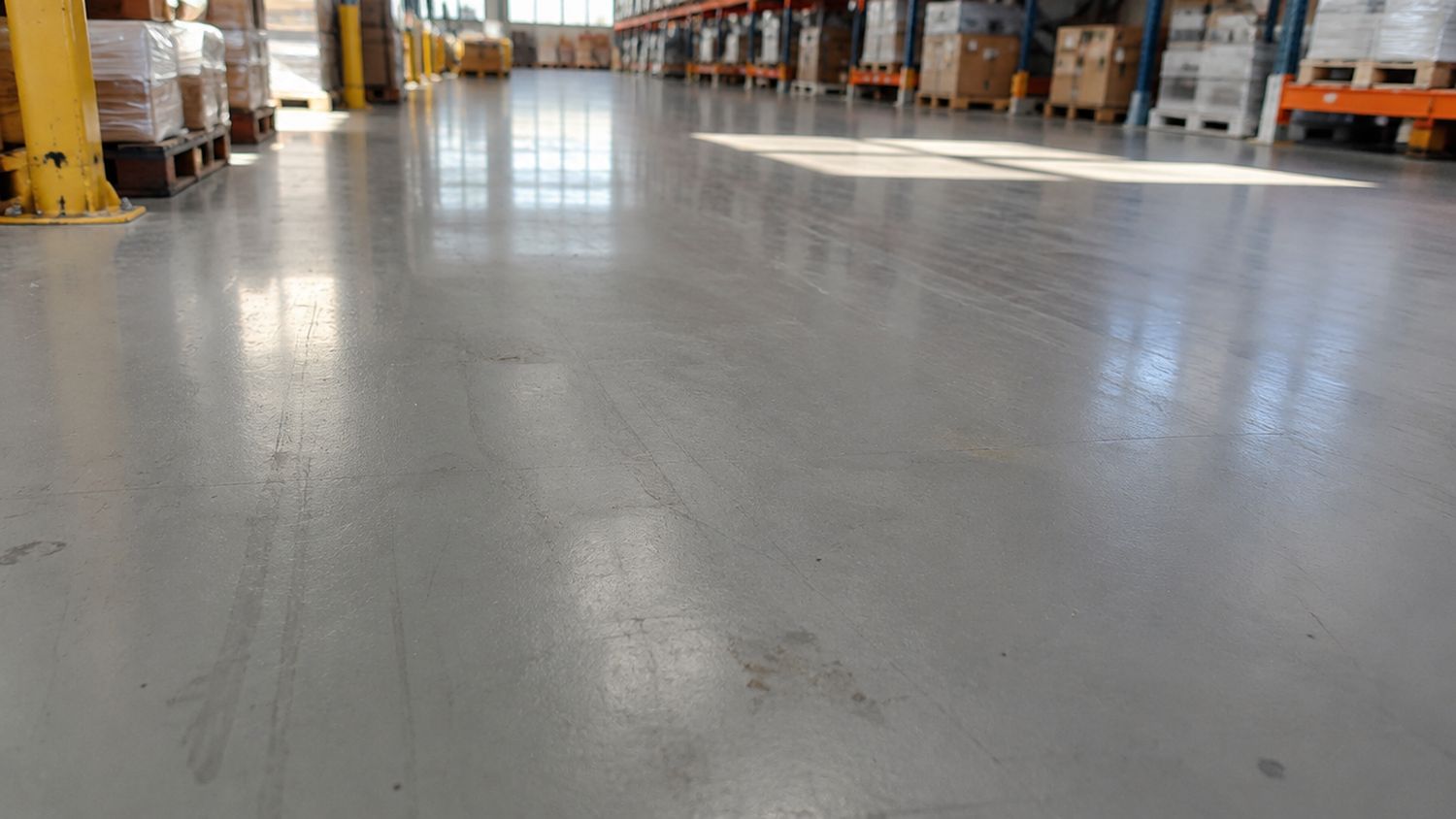
- Warehouses and industrial buildings: large slabs may have uneven moisture because of drainage, loading doors and past leaks. Mapping readings across the floor shows where problems are concentrated.
- Food and beverage plants: constant washing introduces water at the surface, and floors near drains may be saturated. Moisture-tolerant systems are often considered here.
- New construction: fresh slabs release water for a long time. Testing, rather than a calendar date, tells you when the slab is ready.
- Renovations: changes to drainage, plumbing or roofing can alter moisture over time, so a slab that was dry years ago may not be dry now.
Whatever the building type, the principle is the same. Measure what the slab is actually doing, compare it with the limits of the system you plan to install and decide on the evidence.
Documenting Test Results
Good practice is to record where tests were taken, the date, the conditions, the method used and the results. This record helps your installer choose the right system and gives you a clear reference if questions arise later. It also lets you compare readings over time, which is useful if you are waiting for a slab to dry or checking that a drainage fix has worked.
Why you can rely on this guidance. Supreme Epoxy is a commercial, industrial and residential flooring contractor established in 2019, WSIB and business insured, with a 4.9 out of 5 rating from 117 Google reviews. We install the floors we write about, including warehouses completed in as little as three days and overnight installs for operations that cannot stop. This article is general information, not engineering or legal advice. When we visit a site we look at the slab, the history of the building and any signs of moisture before recommending a system. Every site is different, so confirm requirements for your own space.
Standards and Sources
These public sources describe the test methods mentioned above. Check the current version of each standard before relying on it.
- ASTM D4263, Standard Test Method for Indicating Moisture in Concrete by the Plastic Sheet Method
- ASTM F1869, Standard Test Method for Measuring Moisture Vapor Emission Rate of Concrete Subfloor Using Anhydrous Calcium Chloride
- ASTM F2170, Standard Test Method for Determining Relative Humidity in Concrete Floor Slabs Using in situ Probes
- The technical data sheet of the specific coating system, which states the moisture limits that apply to that product
Limits and procedures vary by product and project, so always follow the coating manufacturer’s instructions and the advice of your installer or engineer.
Book a Site Visit
If you are planning a floor and are not sure about the slab, we can inspect it, test it and explain what the results mean for your project. Book a free site visit and we will give you a clear written recommendation.