The floor of a store is part of the brand. Customers read it in a few seconds: is this place clean, modern and well run? It is also a working surface that takes thousands of footsteps, shopping carts, deliveries and spilled coffee. Retailers choosing between epoxy, polished concrete and tile are effectively asking three questions: how will it look, how will it last, and how much trading time will I lose installing it? Request a free estimate to discuss your project.
This guide compares the three options on the things that matter to a retailer, and explains how to decide for your own space. For the services behind each option, see our retail epoxy flooring and concrete polishing pages.
What a Retail Floor Has to Do
- Look right: support the brand and the lighting, from a clean modern look to a warm industrial feel
- Stand up to traffic: handle foot traffic, carts, trolleys and displays being moved
- Be easy to clean: cope with dirt, spills and frequent mopping
- Be safe: give enough grip, especially at entrances in wet and snowy weather
- Install quickly: limit the time the store is closed or disrupted
- Last: keep looking good through years of trade without constant repair
Epoxy: Design Control and a Seamless Surface
Epoxy and related resinous floors are applied as a liquid and bonded to the slab, forming a seamless surface. They can be solid colour, speckled with flake or quartz, metallic with swirling pigments, or finished with a logo or pattern. A clear topcoat adds protection and sets the gloss level.
The strengths are flexibility and repair. Epoxy covers stains, patched areas and imperfect slabs, and can be matched to a brand palette. It is seamless, so there are no grout lines to trap dirt. The trade-offs are that it needs proper preparation and a dry slab, and that high-traffic areas may need the topcoat renewed over time. Our epoxy color chart shows the range of flake and metallic finishes available.
Polished Concrete: The Natural Look
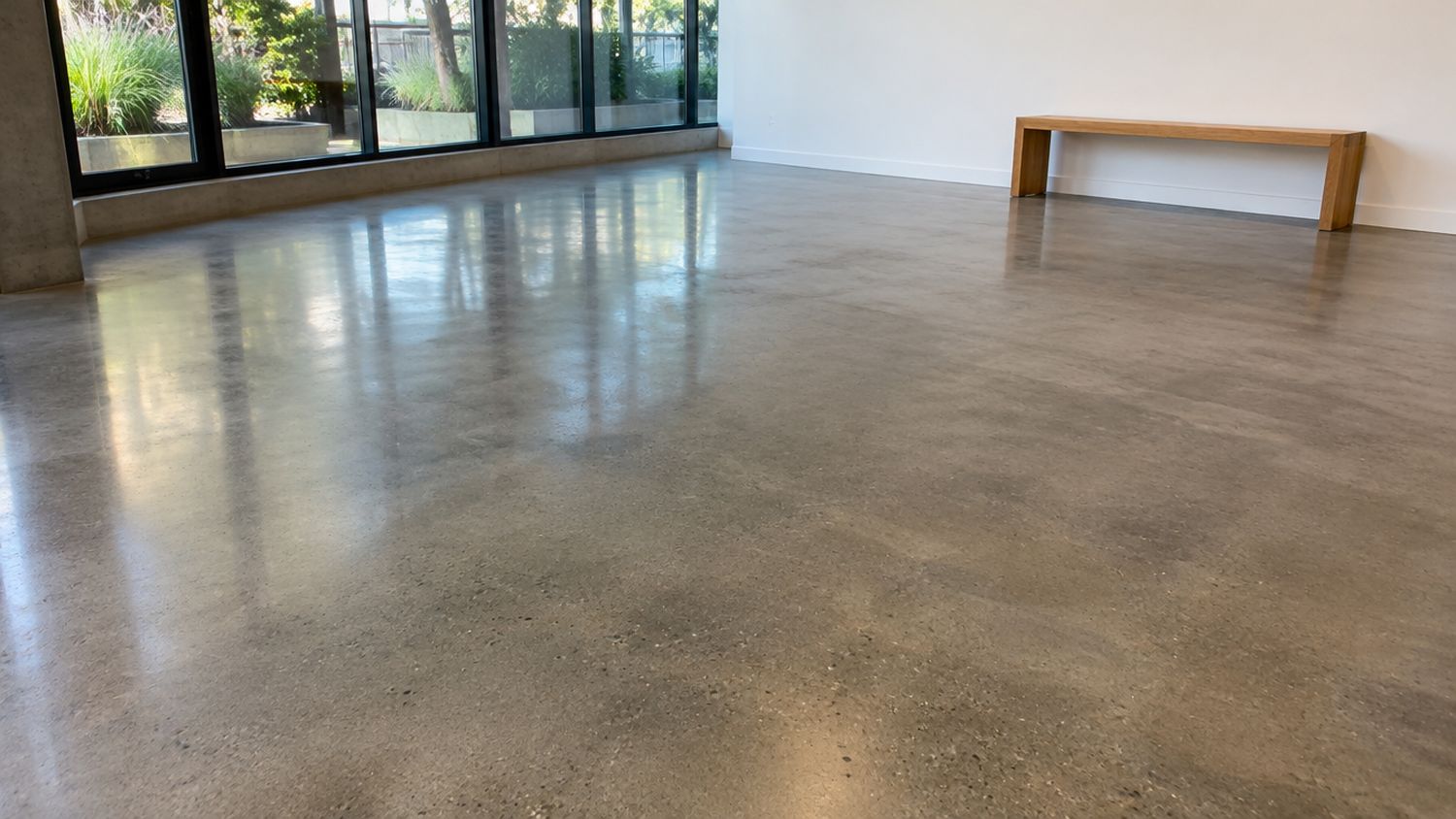
Polished concrete is not a coating. The existing slab is ground with progressively finer diamond tooling, densified and polished to a sheen. The result is a durable surface that shows the natural character of the concrete, including aggregate, trowel marks and variations. It is popular in modern, industrial and minimalist stores.
It works best on slabs that are in good condition and suitable for polishing. A slab with many repairs, stains, thin concrete or uneven colour may not polish to the look you want. Polished concrete is also less forgiving of spills that penetrate, and the look is limited to the slab you have, rather than the design you choose. Our concrete polishing team can tell you whether your slab is suitable.
Tile: Familiar but High-Maintenance
Tile gives a wide choice of colours, sizes and patterns, and many retailers know it well. It also brings grout lines that collect dirt and need sealing and cleaning, edges that can chip, and individual tiles that can crack or loosen. Installation involves a flat, prepared subfloor, setting material and grout cure time, which can mean a longer closure. Repairs are possible, but matching replacement tiles later can be difficult.
Tile can be the right answer for some retail concepts, particularly where a specific look is essential. For many stores, though, the maintenance, grout and installation time make seamless options more attractive.
The decision in one line. Choose polished concrete if your slab is sound and you love the natural look. Choose epoxy if you want design control, need to cover imperfections or want a seamless, branded floor. Choose tile when the specific look demands it and you accept the grout and downtime.
Side-By-Side Comparison
- Design flexibility: epoxy is the highest, tile is high, polished concrete is limited to the slab
- Seams and grout: epoxy and polished concrete are seamless, tile has grout lines
- Slab condition: polished concrete needs a good slab, epoxy tolerates repaired and stained slabs, tile needs a flat subfloor
- Installation time: resinous systems are often quicker than tile, and polished concrete depends on the slab and the finish level
- Maintenance: all three are cleanable. Tile needs grout care, polished concrete needs periodic re-polishing or sealing, epoxy may need topcoat renewal in busy lanes
- Repair: epoxy can be patched and recoated, polished concrete can be re-ground, tile pieces can be replaced if matching stock is available
Lighting, Gloss and How the Floor Reads
Gloss level changes how a store feels. A high-gloss floor reflects light and makes a space feel brighter, but it also shows scratches and footprints. A satin or matte finish hides marks and reduces glare. Lighting design interacts with the floor, so it is worth looking at samples under your own lights. Flake and speckled finishes also hide dirt and wear better than a plain solid colour.
Safety at Entrances and in Wet Weather
Toronto winters bring snow, salt and meltwater into stores. Entrances and vestibules need grip. Resinous systems can be finished with fine anti-slip texture in those areas, while keeping a smoother surface in the main sales floor. Walk-off mats and a cleaning plan add protection. If you are concerned about slip risk, ask for slip-resistance information on the exact finish you are considering.
Keeping the Store Open
Retailers cannot afford long closures, and installation planning is as important as product choice. Strategies include working after hours and on weekends, phasing the floor in sections, using fast-curing coatings and preparing the space in advance. We cover overnight work in more detail in our article on installing floors without closing your business.
Preparing the Slab
Whichever option you choose, preparation decides the outcome. Slabs need to be tested for moisture, cleaned of adhesive and old coatings, repaired where needed and ground to the right profile. Skipping steps leads to peeling, bubbling and uneven finishes. Our commercial epoxy flooring page explains the process.
Choosing for Your Own Store
- Start with the slab: ask for an assessment of whether it can be polished or needs a coating
- Decide the look and the brand story, then choose the finish that delivers it
- View samples under your own lighting, not just in a brochure
- Ask about grip at entrances and wet areas
- Plan the install around trading hours and delivery schedules
- Ask how the floor will be maintained and renewed over time
Thinking About Cost Beyond the Material
Retailers often compare floors on the price per square foot of the finished surface. A more useful comparison covers the whole life of the floor. That includes preparation and repairs, installation time and the trading days lost, maintenance and cleaning, and the cost of repair or renewal later. A floor that looks cheaper on paper but needs weeks of closure, regular grout cleaning and periodic replacement is not necessarily cheaper in practice.
When you collect quotes, ask each contractor for a written scope that describes the preparation, the system, the finish, the schedule and what is not included. It is the only way to compare like with like. Our epoxy flooring cost guide explains the factors that drive any quote.
Design Ideas That Work in Retail
- Speckled flake in a light tone: hides dirt and wear while keeping a bright, clean look
- Solid colour with a brand accent: a border, a stripe or a feature area at the entrance or till
- Metallic finishes for a statement space: a feature floor in a showroom or boutique that photographs well
- Zoned finishes: a smoother surface in the main sales area and a grippier one at the entrance
- Polished concrete with exposed aggregate: a natural look for modern and industrial concepts, where the slab allows it
Our metallic epoxy flooring page shows what a feature floor can look like.
What We Check at a Retail Site Visit
- The condition of the slab, including cracks, previous coatings, adhesive residue and moisture
- The lighting plan and how it will reflect off different finishes
- Traffic patterns, entrances, wet-weather zones and areas with heavy fixtures
- Trading hours, delivery schedules and when work can happen
- The existing and planned fixtures, so edges and cut-outs are detailed correctly
Maintenance Routines for Each Floor Type
- Epoxy and resinous floors: sweep or dust-mop daily, damp-mop with a neutral cleaner, and inspect high-traffic lanes for topcoat wear
- Polished concrete: keep it free of grit, clean with products made for polished surfaces and plan periodic re-polishing or sealing
- Tile: clean grout lines regularly, reseal grout where required and replace cracked tiles promptly
Whatever you choose, entrance mats cut the amount of grit that reaches the sales floor, which extends the life of every surface.
Why you can rely on this guidance. Supreme Epoxy is a commercial, industrial and residential flooring contractor established in 2019, WSIB and business insured, with a 4.9 out of 5 rating from 117 Google reviews. We install the floors we write about, including warehouses completed in as little as three days and overnight installs for operations that cannot stop. This article is general information, not engineering or legal advice. We install resinous and polished floors in retail units and showrooms, so we can advise on either route. Every site is different, so confirm requirements for your own space.
Book a Free Site Visit
The best way to choose is to have someone look at your slab and discuss your design goals. Book a free site visit and we will assess the concrete, show you samples and give you a written recommendation, whether the answer is epoxy, polished concrete or a combination.